The words “lab coat”, “coverall” and “apron” describe different levels of body coverage. They do not, on their own, establish protection against a chemical, biological material or particle. For a purchase that supports a laboratory procedure, start with the task and the facility's risk assessment, then check the supplied garment's construction and documentation. This guide compares the styles currently listed in Lab Supply's Disposables category and shows what to put on a quotation request.
Begin with the area you need to cover
A coat covers the torso and arms while leaving the legs largely exposed. A coverall can cover the torso, arms and legs as one garment, depending on its design. An apron mainly protects the front of the wearer and may be layered over other clothing when the local procedure permits. These are practical descriptions, not certification claims. If exposure can reach a wrist, neck, back or lower leg, examine those areas explicitly instead of choosing by product name.
Write down the operation, expected splash or particulate exposure, movement required and how long the garment is worn. Note whether the garment must be disposable, whether it will be changed between work zones and what under-clothing is specified. The WHO laboratory biosafety manual frames PPE selection around a risk assessment; a generic catalogue label cannot replace that assessment.
Disposable lab coats for routine coverage
The listed non-woven lab coat is white, 40 GSM, with elastic cuffs, a collar and five hook-and-loop fasteners. Its page describes one size and a dimensional diagram. Those are useful selection details: check whether the chest, arm, cuff and overall length fit your users, and whether the closure works with the task. “One size fits all” is a commercial description, not proof that every wearer will have adequate coverage.
Use the coat only within the limitations of its documented material and construction. The listing does not publish chemical permeation data, liquid-barrier performance or a sterile claim. If a protocol needs any of those, request the exact manufacturer's specification. A reusable coat and a disposable non-woven coat may also serve different laundering and contamination-control processes; do not switch between them without reviewing the procedure.
Non-woven and microporous coveralls are different products
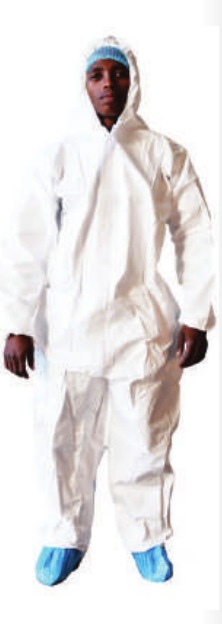
The non-woven coverall is listed as white, 40 GSM, in sizes M–XXXL. Its gallery carries a size chart, which should be checked against users' measurements and the range of motion needed. A garment that pulls across the shoulders or separates at the cuff can perform poorly in real use even when the nominal size looks correct.
The microporous Type 5/6 coverall is a separate 60 GSM listing. The catalogue image cited on its page states Category III, Type 5-B particle protection, Type 6-B limited liquid splash protection and anti-static properties. Those claims can matter in a tender or safety decision. Before relying on them, obtain the declaration of conformity and applicable test reports for the exact variant, size and supplier batch. Do not assume that a 40 GSM non-woven coverall shares the same classification, or that a Type 5/6 claim covers every chemical exposure.
PE aprons: compare dimensions and film, not just names
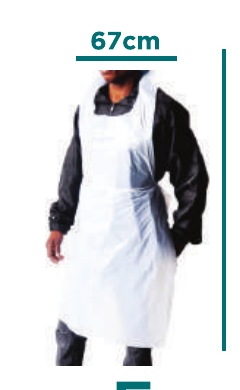
Lab Supply lists several polyethylene aprons. The standard PE apron is described as 65 × 110 cm and 20 micron low-density recycled polyethylene. The light-duty apron is 60 × 100 cm and 15 micron recycled polyethylene, while the heavy-duty apron is 67 × 110 cm and 30 micron virgin low-density polyethylene. Other header-card, HDPE economy and Premium Plus options have different stated materials or thicknesses.
These measurements help you compare front coverage and packaging, but film thickness alone does not prove resistance to a particular substance or give a safe exposure duration. Ask for chemical compatibility evidence if the apron is intended as protective equipment. Confirm ties, neck opening, dimensions on the wearer and whether the garment must be food-contact suitable or meet any site-specific rule; do not infer those properties from a colour or label.
Extend coverage deliberately
An apron or coat may leave forearms or wrists exposed. The catalogue includes a PE sleeve protector, Premium Plus sleeve protector and non-woven wrist cover. If these are specified as part of an ensemble, check how they overlap with the glove and garment during movement. A gap at the cuff can undermine the intended coverage. Ask the safety lead whether a disposable layer is appropriate and how it should be removed and discarded after the task.
Fit, storage and change frequency
Quantity planning should include sizes, frequency of changes, staff count and task peaks. Request units per bag and bags per carton, plus the current availability of every size and colour. A single sitewide “in stock” label does not guarantee all variants are available. Check storage conditions and any expiry or lot-traceability requirements for protective garments. If different work areas use different colours, define that system in your own procedure and specify the colours on the order.
A clear quote request
For each garment, provide the exact product link, size mix, intended task, expected exposure, material or classification requirement, quantity, location and required documentation. State whether substitutions are permitted. If a classification or barrier claim is essential, ask for the current datasheet and declaration before accepting an alternative. Use the Lab Supply quote form to send this brief. For a broader order structure, see the laboratory disposables buying guide once available.
For repeat purchasing, keep a short approval record that identifies the garment variant, datasheet version, acceptable sizes and the work areas where it may be used. This prevents an apparent like-for-like substitute from changing the material or coverage without review. When users report tearing, poor fit or heat discomfort, record the task and size involved; the feedback may point to a sizing or process problem rather than a blanket need for a heavier garment.
Frequently asked questions
Is a disposable lab coat the same as a coverall?
No. A coat and coverall differ in coverage and construction. Select by the task, fit and documented product performance.
Does a heavier apron automatically protect against chemicals?
No. Thickness is only one specification. Chemical compatibility and exposure duration need product-specific evidence.
Can the Type 5/6 coverall be specified by its catalogue image alone?
Request current documentation for the exact supplied model and size whenever the classification affects a safety or tender decision.