Head and footwear covers are small purchasing lines with large operational consequences. If a cap slips, a beard cover leaves facial hair exposed, or a shoe cover tears at a doorway, the item may not support the work area's contamination-control plan. Product selection begins with the process and the site's documented requirements, then the actual material, size and construction. This guide compares the covers in Lab Supply's Disposables category and helps buyers specify the right variant without assuming that a product name equals a cleanroom, medical or safety certification.
Define the work-zone rule first
Ask the area owner which spaces require head, beard or footwear coverage and where the items are donned, changed and removed. Identify whether the aim is product protection, housekeeping, visitor management or another controlled process. A general-purpose cover may not meet the specifications of a classified cleanroom or clinical facility. If a standard or validated particulate-shedding limit applies, request documentary evidence for the offered item. Do not infer suitability from colour, GSM or the phrase “premium”.
Write down how many people cross the boundary per shift, how often they re-enter and whether visitors need different sizes. A product that fits most regular staff may still fail for visitors or for people wearing bulky footwear. Placement of dispensers and waste bins can also affect compliance. Selection, training and the site's procedure should be considered together.
Mob caps: circumference and construction matter
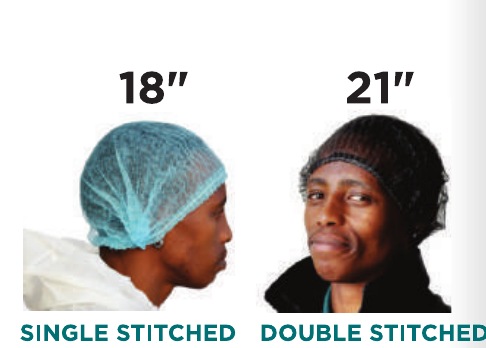
The standard Mob Cap page lists 10 GSM material per piece, with 18-inch single-stitched and 21-inch double-stitched options. It shows several colours. The Premium Plus Mob Cap is a separate 24-inch, double-stitched, 15 GSM listing with a smaller stated colour range. These are not simply two prices for the same cap. Ask which circumference covers the wearer's hair fully and remains in place during the task. Check the actual fit on people with different hair lengths and styles before standardising a size.
If colour denotes a work area or role, write down the mapping in the site's procedure and specify the exact cap size and colour on the purchase order. Do not rely on the photograph to confirm every combination is supplied. Check units per bag and bags per carton, since the public product pages describe dimensions and options but do not state pack counts.
Beard covers: check the coverage boundary
The Beard Cover is listed as 18-inch, single-stitched, 10 GSM per piece, with a machine-made headband and white or black colour. The correct fit depends on facial-hair length and how the headband sits with other protective equipment. Trial the cover with the site's required cap, mask or eye protection to see whether it shifts when the wearer talks or bends. If the facility needs a specific material or particle-control performance, request the manufacturer's test data for the exact supplied product. The listing does not publish a cleanroom classification.
Where facial-hair coverage is required, it should be addressed explicitly in training and visitor instructions. A generic head cap does not automatically cover a beard. Similarly, a beard cover is not a respirator or face mask. Each item has a different purpose, and combining them needs an area-specific procedure.
Non-woven versus CPE shoe covers
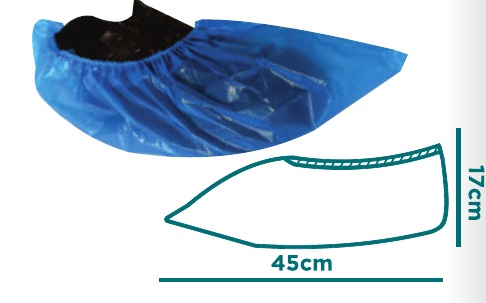
Lab Supply lists Non-woven Shoe Covers at 46 × 16 cm, 30 GSM, elasticated, machine-made and double-stitched, in white or blue. The CPE Shoe Cover is listed as 40 × 15 cm chlorinated polyethylene, with light-duty 2.4 g and standard 3.6 g options, in blue. The Premium Plus CPE Shoe Cover is a separate blue, 50-micron, 7 g option whose diagram shows 45 × 17 cm.
These published dimensions and materials help narrow a shortlist. Check them against the footwear actually worn in the facility. Ask whether the sole design, grip and durability suit the floor and movement pattern; the public listings do not publish a slip-resistance rating, so none should be assumed. If splash or chemical resistance matters, obtain evidence for the exact cover and expected exposure. A shoe cover is not a substitute for appropriate protective footwear.
Test fit at the doorway
A short sample trial can uncover issues before a carton purchase. Have representative staff and visitors put on and remove each cover using the actual doorway setup. Observe whether caps stay over the hairline, beard covers contain the required area and shoe covers accommodate the largest permitted footwear without tearing. Check whether the elastic causes discomfort or the cover drags on the floor. Record any size or process failures, then revise the purchase brief. The trial supports usability; it does not replace performance testing or certification.
Plan disposal and change frequency around the site's rules. If covers must be changed after leaving a zone, estimate usage from entries rather than headcount alone. Keep spare sizes and colours where visitors enter. Confirm storage requirements and whether packaging can be dispensed without exposing the remaining items to the work area.
A quote request that prevents substitution errors
Send the supplier the exact Mob Cap, Premium Plus Mob Cap, Beard Cover, Non-woven Shoe Cover or CPE Shoe Cover URL. State size, colour, material, expected monthly usage, pack quantity, delivery location and any documented performance requirement. If an alternative is offered, compare dimensions and documentation rather than accepting the broad product name. The Lab Supply quote form provides a place to send the list.
The WHO's laboratory biosafety guidance treats protective clothing and footwear as parts of a risk-based laboratory system. This is why the buying decision belongs with the facility's operating rules, rather than a catalogue image alone.
Frequently asked questions
Are all mob caps suitable for cleanrooms?
No. The public listings give size, stitching, material weight and colours, but do not publish a cleanroom classification. Request relevant evidence if one is required.
Does a CPE shoe cover replace safety footwear?
No. Select footwear for the workplace hazard and use covers only where the local procedure specifies them.
Why quote by exact product URL?
Several similarly named variants differ in dimensions, weight or material. A URL plus the required size and colour reduces substitution mistakes.